Have you ever paused while writing and wondered whether to use imminent or eminent? You’re not alone. These two words look and sound similar, which makes them one of the most commonly confused word pairs in English.
A single letter can completely change the meaning of your sentence, leading to misunderstandings in both casual and professional writing. The confusion becomes even more common because both words are frequently used in news articles, academic content, business communication, and everyday conversations.
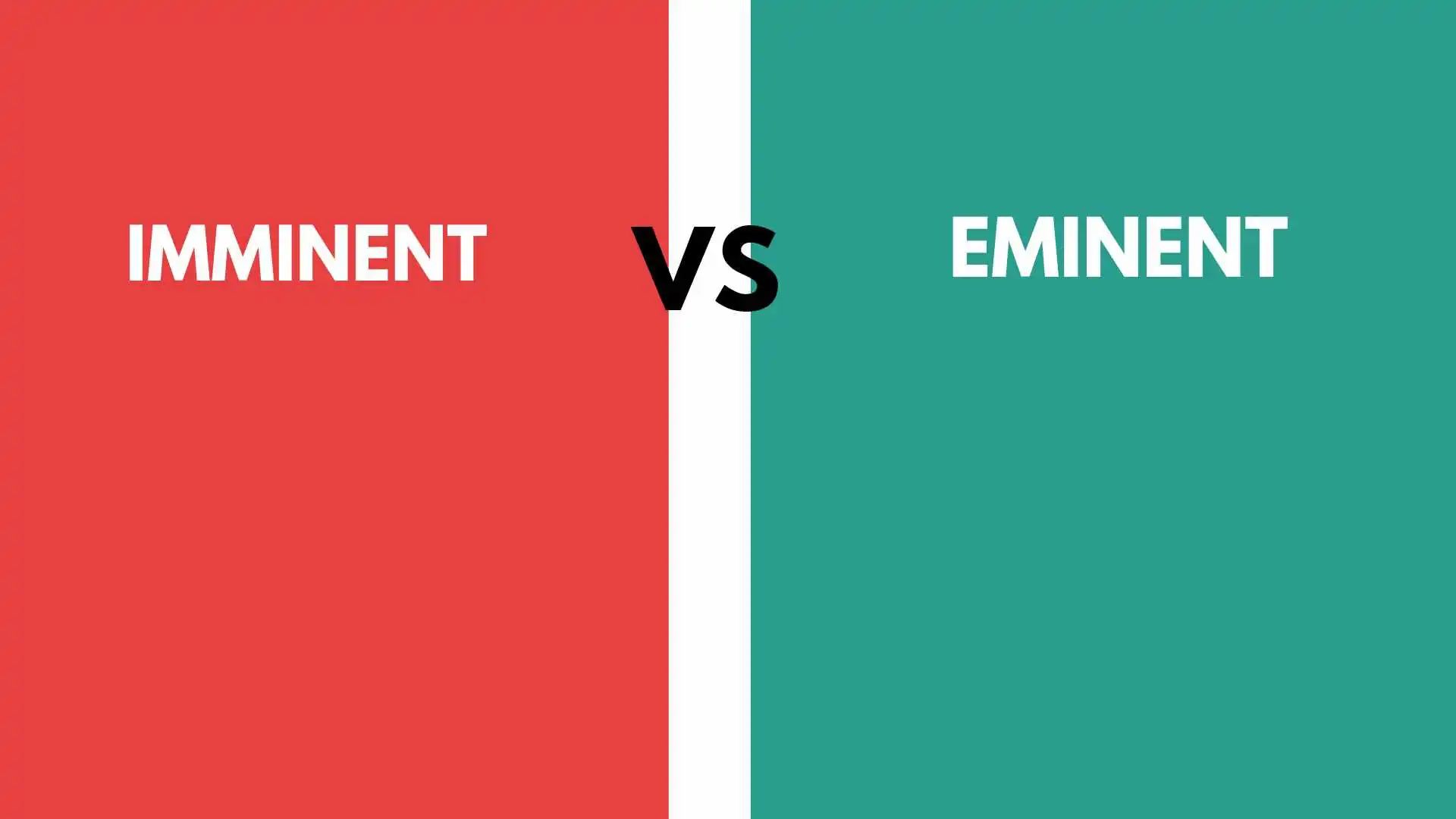
While imminent relates to something that is about to happen, eminent refers to someone who is respected, famous, or distinguished in a particular field.
⚡ Quick Answer: Imminent or Eminent?
Here is the simplest way to understand imminent or eminent:
- Imminent = Something about to happen very soon (time-related)
- Eminent = Someone or something famous, respected, or highly important (status-related)
✔ Correct Usage:
- A storm is imminent → (happening soon)
- She is an eminent scientist → (highly respected)
❌ Incorrect Usage:
- A storm is eminent ❌
- He is an imminent doctor ❌
👉 Quick trick:
- Imminent = Incoming event
- Eminent = Excellent person
Meaning of Imminent or Eminent (Detailed Explanation)
What does “Imminent” mean?
The word imminent refers to something that is about to happen very soon, usually something expected and often unavoidable.
📌 Definition:
Imminent (adj.) – about to happen in the near future.
🔹 Examples:
- A flood is imminent due to heavy rain.
- The company announced an imminent product launch.
- Dark clouds suggest an imminent storm.
👉 Think of it as something “just around the corner.”
What does “Eminent” mean?
The word eminent refers to someone or something that is highly respected, famous, or distinguished in a particular field.
📌 Definition:
Eminent (adj.) – famous, respected, or outstanding.
🔹 Examples:
- He is an eminent lawyer in the country.
- She met an eminent scientist at the conference.
- The university invited an eminent speaker.
👉 Think of it as someone “standing above others” in reputation.
Why “Imminent or Eminent” Causes Confusion
The confusion between imminent or eminent happens for three main reasons:
1. Similar pronunciation
Both words sound almost identical, especially in fast speech.
2. Same spelling pattern
Both start with “e/i + minent,” making them visually confusing.
3. Lack of context understanding
Without context, learners cannot easily identify whether the sentence is about time (imminent) or status (eminent).
Grammar Rules for Imminent or Eminent
Understanding grammar rules helps you avoid mistakes when using imminent or eminent.
✔ Rule for “Imminent”
- Always used for events or situations
- Usually refers to something negative or urgent
Examples:
- Danger is imminent.
- War seemed imminent.
✔ Rule for “Eminent”
- Always used for people or achievements
- Refers to respect, fame, or authority
Examples:
- An eminent professor gave a lecture.
- She is an eminent writer.
🧠 Memory Tricks to Remember Imminent or Eminent
Here are simple tricks to never confuse imminent or eminent again:
🔹 Trick 1: “I” for Imminent = Incoming
- Imminent starts with I
- Think: something is Incoming (about to happen)
2: “E” for Eminent = Excellent
- Eminent starts with E
- Think: someone is Excellent and famous
🔹 Trick 3: Time vs Fame Rule
- Imminent = Time (soon)
- Eminent = Fame (status)
📊 Imminent or Eminent Comparison Table
| Feature | Imminent | Eminent |
| Meaning | About to happen soon | Famous or highly respected |
| Usage | Events, situations | People, professionals |
| Tone | Urgent / serious | Positive / respectful |
| Example | Imminent danger | Eminent scientist |
| Category | Time-based | Status-based |
✍️ Real-Life Examples of Imminent or Eminent
🔹 Imminent Examples:
- The earthquake warning suggests an imminent threat.
- His resignation seemed imminent after the controversy.
- A financial crisis is imminent.
🔹 Eminent Examples:
- She is an eminent cardiologist in the city.
- The award was given to an eminent author.
- He consulted an eminent historian.
🌍 British vs American English: Imminent or Eminent
The good news is that imminent or eminent have:
✔ No spelling differences
Both British and American English use the same spelling.
✔ No meaning differences
The meanings remain exactly the same across both versions.
📌 Examples:
- UK: An imminent storm is approaching.
- US: An imminent storm is approaching.
👉 So, there is no regional confusion—only meaning confusion!
❌ Common Mistakes with Imminent or Eminent
❌ Wrong vs ✔ Correct Usage
- ❌ The eminent storm is dangerous
✔ The imminent storm is dangerous - ❌ He is an imminent doctor
✔ He is an eminent doctor - ❌ An eminent disaster is coming
✔ An imminent disaster is coming
👉 Always check:
Is it about time or fame?
💡 Pro Tips to Use Imminent or Eminent Correctly
✔ Tip 1: Ask the “What” question
- What is happening? → Imminent
- Who is involved? → Eminent
2: Look for context clues
- Words like danger, storm, crisis → Imminent
- Words like doctor, professor, leader → Eminent
✔ Tip 3: Practice with sentences
The more examples you read, the faster you’ll master them.
🧾 Examples in Different Contexts
🔹 News Context:
- The government warned of an imminent economic crisis.
Academic Context:
- An eminent researcher published a new study.
🔹 Daily Life:
- Rain feels imminent, so carry an umbrella.
- She met an eminent chef at the event.
❓ FAQ: Imminent or Eminent
1. What is the main difference between imminent and eminent?
Imminent means something is about to happen, while eminent means someone is famous or respected.
2. How do I remember imminent or eminent easily?
Think “imminent = incoming event” and “eminent = excellent person.”
3. Can imminent be used for people?
No, imminent is only used for events or situations.
4. Can eminent be used for events?
No, eminent is used for people or achievements.
5. Is imminent always negative?
Not always, but it is commonly used for urgent or serious situations.
6. Are imminent and eminent pronounced the same?
Yes, they sound very similar, which is why confusion happens.
7. Is there a spelling difference in UK and US English?
No, both words are spelled the same in British and American English.
🧾 Conclusion: Mastering Imminent or Eminent
Understanding imminent or eminent is essential for clear and accurate communication. Although they sound similar, their meanings are completely different one refers to time (something about to happen), and the other refers to status (someone highly respected).