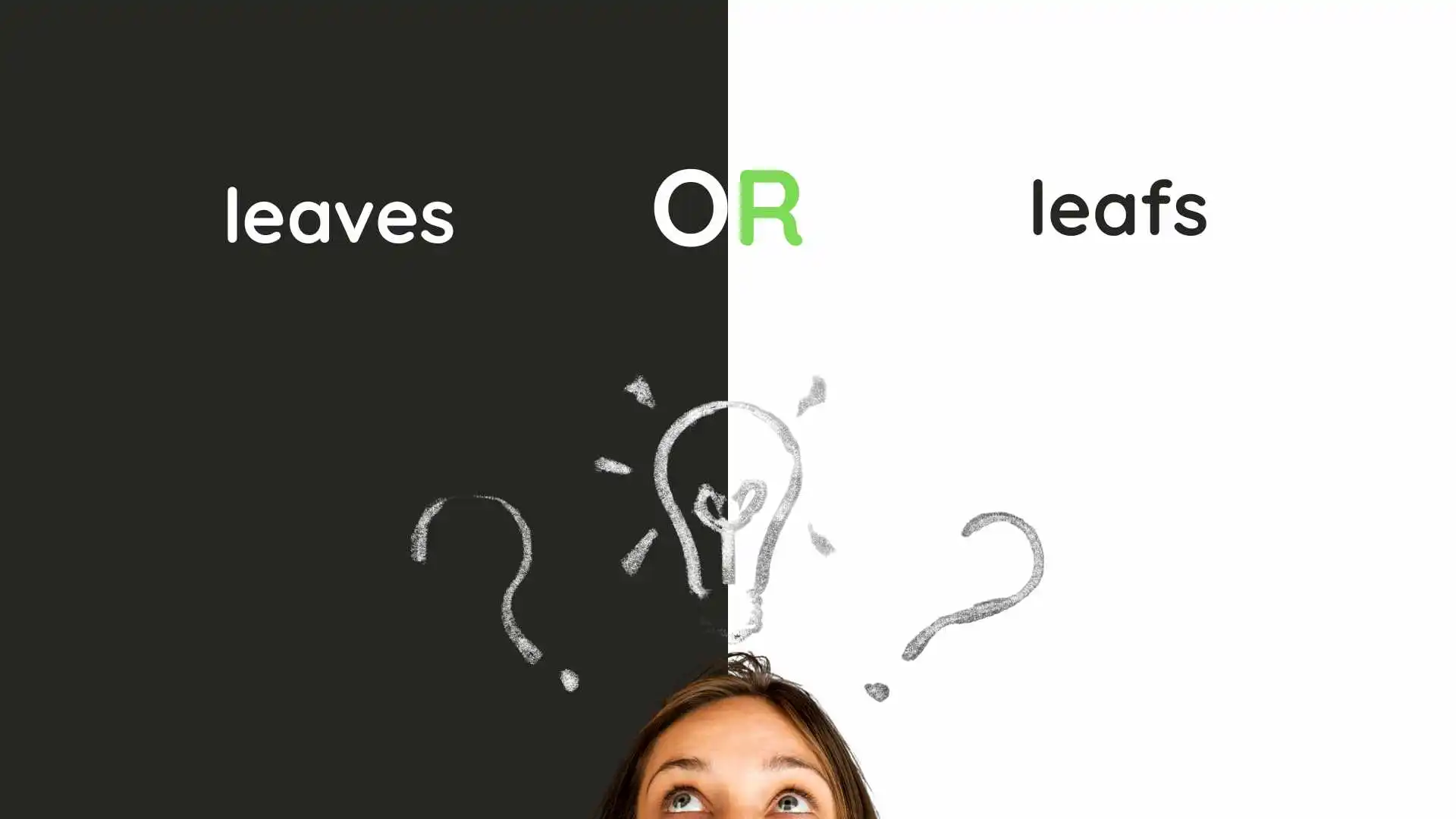
Confused between “leaves” and “leafs”? You’re not alone. This small spelling difference often trips people up, especially in everyday writing and grammar tests. At first glance, both words might seem correct but only one is commonly used in standard English. 🤔
You’re talking about the green parts of a tree or trying to improve your grammar skills, understanding the difference between leaves and leafs is important. In this guide, we’ll break it down in a simple and clear way so you can use the right word with confidence every time. 🌿✨
⚡ Quick Answer: Leaves or Leafs
- ✅ Leaves = Correct plural of leaf (used in almost all cases)
- ❌ Leafs = Incorrect (except in very rare proper nouns like team names)
👉 Example:
- Correct: The tree has green leaves
- Incorrect: The tree has green leafs
📘 Meaning and Definition of Leaves or Leafs
What Does “Leaf” Mean?
A leaf is a flat, green part of a plant or tree that helps it grow by absorbing sunlight. It can also mean a page in a book.
What Is the Plural of Leaf?
The correct plural of leaf is leaves.
👉 Examples:
- The wind blew the leaves off the tree.
- She turned the leaves of the old book carefully.
What About “Leafs”?
The word leafs is generally considered incorrect in standard English. However, it may appear in:
- Proper names (like sports teams)
- Very rare informal or incorrect usage
🤔 Why Does the Confusion Happen?
The confusion between leaves or leafs comes from how English forms plurals.
Most nouns simply add -s:
- Cat → Cats
- Book → Books
But some words ending in -f or -fe change differently:
- Leaf → Leaves
- Knife → Knives
- Life → Lives
This irregular pattern makes people assume “leafs” might be correct—but it’s not.
📏 Grammar Rules: Leaves or Leafs Explained
Rule 1: Words Ending in -F Change to -VES
Many English nouns ending in -f change to -ves in plural form.
👉 Examples:
- Leaf → Leaves
- Wolf → Wolves
- Shelf → Shelves
Rule 2: Not All -F Words Follow This Rule
Some words simply add -s:
- Roof → Roofs
- Chief → Chiefs
👉 That’s why people get confused and think “leafs” might work too.
Rule 3: “Leaves” Is the Standard Plural
For the word leaf, the only grammatically correct plural is leaves.
🧠 Easy Memory Tricks to Remember
Struggling to remember leaves or leafs? Try these simple tricks:
🌿 Trick 1: Think of Nature
Trees don’t have “leafs”—they always have leaves.
🔤 Trick 2: Replace F with V
If a word ends in f, try switching it to v + es:
- Leaf → Lea + ves = Leaves
📚 Trick 3: Compare with Similar Words
- Knife → Knives
- Life → Lives
👉 So naturally: Leaf → Leaves
📊 Leaves vs Leafs: Side-by-Side Comparison
| Feature | Leaves ✅ | Leafs ❌ |
| Correct spelling | Yes | No (mostly incorrect) |
| Usage | Standard English | Rare/proper nouns only |
| Grammar rule | F → VES | Incorrect plural formation |
| Example | Tree leaves | Not used in normal writing |
| Acceptable context | Everyday language | Team names (e.g., Maple Leafs) |
🌍 British vs American English
Good news—there’s no difference between British and American English for this word.
🇬🇧 British English:
- Correct: Leaves
🇺🇸 American English:
- Correct: Leaves
👉 Both versions follow the same rule. “Leafs” is still incorrect in both.
📝 Examples of Leaves in Real-Life Usage
🌳 Nature Context
- The autumn leaves turned golden and red.
- The tree shed its leaves in winter.
📖 Books Context
- She flipped through the leaves of the notebook.
- Ancient manuscripts had fragile leaves.
🍃 Figurative Use
- He took a leaf out of her book.
- The project turned over a new leaf.
❌ Common Mistakes to Avoid
Here are mistakes people often make when using leaves or leafs:
❌ Incorrect:
- The tree has many leafs
- Autumn leafs look beautiful
✅ Correct:
- The tree has many leaves
- Autumn leaves look beautiful
👉 Always double-check when writing plural forms of irregular nouns.
💡 Pro Tips to Use Leaves Correctly
✔ Always use leaves when talking about more than one leaf
✔ Avoid “leafs” unless it’s a proper noun
✔ Read your sentence out loud—it often sounds wrong if incorrect
✔ Practice with similar words like lives, knives, wolves
✔ Use grammar tools to double-check your writing
🔍 Deep Dive: Are There Any Exceptions?
Yes—but they’re very rare.
🏒 Proper Nouns Example:
- Toronto Maple Leafs (a hockey team)
In such cases, “leafs” is used intentionally as a name—not as standard grammar.
👉 Outside of these cases, always stick with leaves.
📚 Advanced Understanding: Linguistic Insight
The transformation from leaf → leaves comes from Old English plural patterns. Over time, some words kept this irregular form while others simplified.
That’s why English feels inconsistent:
- Half → Halves
- Calf → Calves
- But: Roof → Roofs
👉 Language evolves, but “leaves” has remained the accepted standard.
❓ Frequently Asked Questions (FAQs)
1. Is it leaves or leafs?
👉 Leaves is correct. “Leafs” is incorrect in standard usage.
2. Why is leaf pluralized as leaves?
👉 Because words ending in -f often change to -ves in plural form.
3. Can I ever use leafs?
👉 Only in proper nouns like team names, not in regular writing.
4. Is leafs grammatically wrong?
👉 Yes, in most cases, it is considered incorrect.
5. What is the plural of leaf in books?
👉 It is still leaves.
6. Do British and American English differ here?
👉 No, both use leaves.
7. How can I remember leaves easily?
👉 Think of knife → knives, so leaf → leaves.
🏁 Conclusion: Leaves or Leafs — Final Verdict
When it comes to leaves or leafs, the answer is simple and clear:
👉 “Leaves” is the correct plural form of “leaf.”
While “leafs” might appear in rare proper nouns, it is not acceptable in standard grammar. By understanding the rules, patterns, and memory tricks, you can confidently use the correct form every time.
Mastering small details like this improves your writing and builds trust with your readers. So next time you write about trees, books, or anything similar remember, it’s always leaves, not leafs. 🌿