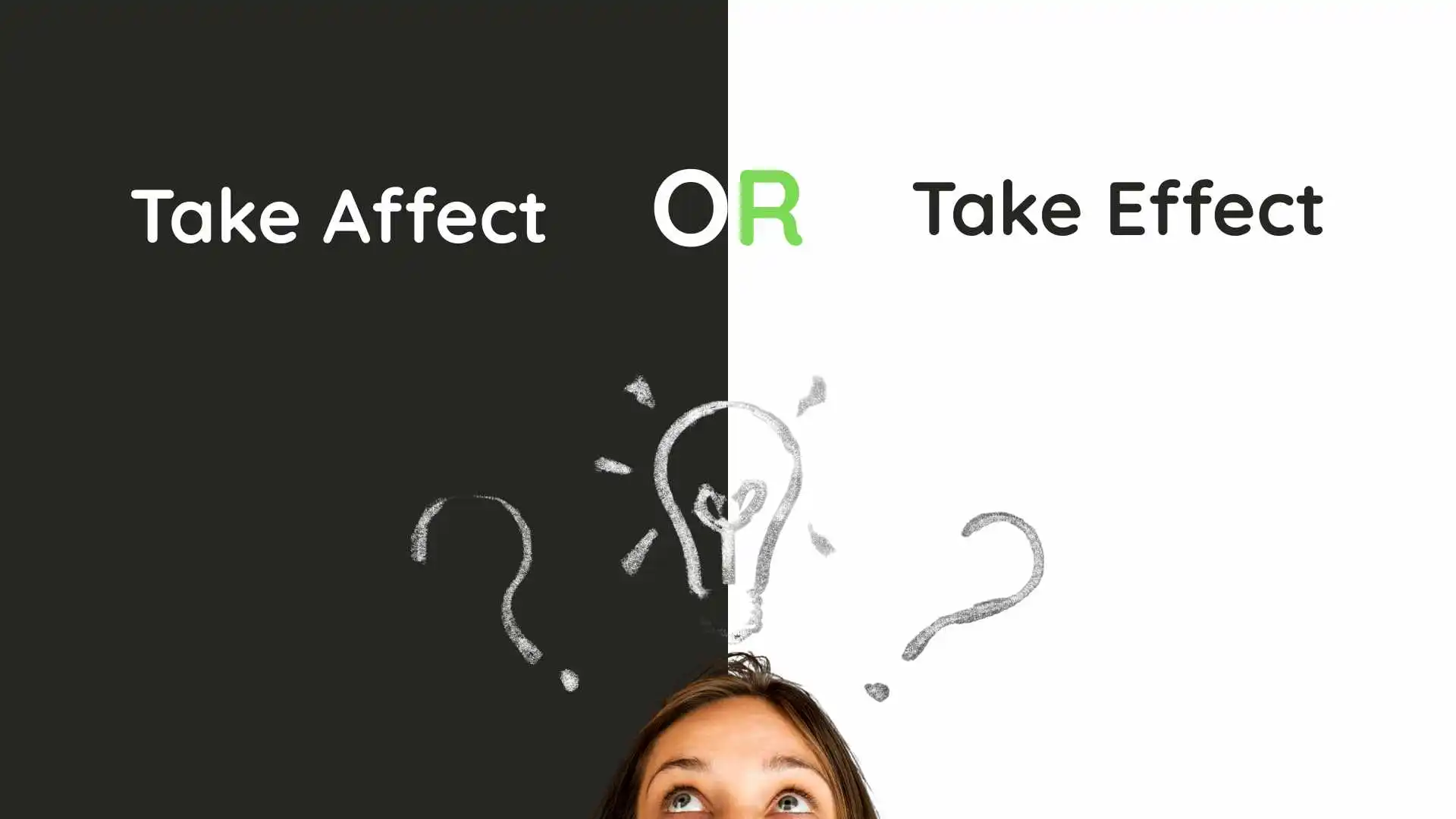
Understanding Take Affect vs Take Effect is one of the most common grammar confusions in English writing. Many students, writers, and even professionals struggle to choose the correct phrase because both look similar and sound almost identical.
However, their meanings are completely different, and using the wrong one can change the meaning of your sentence entirely.
In this detailed guide on Take Affect vs Take Effect, you will learn the correct usage, grammar rules, real-life examples, memory tricks, and common mistakes so you can use them confidently in writing and speaking.
⚡ Quick Answer: Take Affect vs Take Effect
Here is the simplest explanation of Take Affect vs Take Effect:
- ❌ “Take Affect” = Incorrect in standard English
- ✔ “Take Effect” = Correct phrase
✔ Correct usage:
- The new law will take effect tomorrow.
❌ Incorrect usage:
- The new law will take affect tomorrow. (Wrong)
👉 Key rule:
- Effect = Result (Correct phrase: take effect)
- Affect = Verb (not used in this phrase)
Meaning and Definition of Take Affect vs Take Effect
📌 What does “Take Effect” mean?
The phrase take effect means something begins to work, become active, or start producing results.
✔ Simple meaning:
- To start working
- To become active
- To begin functioning
Examples:
- The medicine will take effect in 30 minutes.
- The new policy will take effect next month.
- The rules take effect immediately.
👉 In short: Take effect = something starts working
📌 Why “Take Affect” is Incorrect
The phrase “take affect” is grammatically incorrect in standard English.
This is because:
- “Affect” is usually a verb meaning “to influence”
- It does not correctly form the phrase “take affect”
✔ Correct phrase is always:
- Take effect
Why Confusion Happens in Take Affect vs Take Effect
The confusion between Take Affect vs Take Effect happens due to several reasons:
1. Similar spelling
- Affect
- Effect
Only one letter difference makes them confusing.
2. Similar pronunciation
They sound very similar in spoken English.
3. Both are grammar-heavy words
Both words are often used in formal writing and exams.
4. Interchangeable misuse
Many learners mistakenly replace one with the other.
👉 But remember: only “take effect” is correct
Grammar Rules for Take Affect vs Take Effect
📌 Rule 1: “Take Effect” is a fixed phrase
It is always used together.
✔ Structure:
- Subject + will/shall + take effect
Examples:
- The law will take effect soon.
- The changes take effect immediately.
📌 Rule 2: “Affect” is NOT used in this phrase
“Affect” is a verb meaning:
- To influence something
Examples:
- Cold weather affects health.
- Stress affects performance.
❌ But never:
- take affect (wrong)
Memory Tricks to Remember Take Affect vs Take Effect
Here are easy tricks to never confuse them again:
💡 Trick 1: Effect = End result
- Law → result → take effect
Trick 2: A = Action, E = End result
- Affect = Action (verb)
- Effect = End result (noun)
💡 Trick 3: Think “Effective”
- If something becomes effective → it takes effect
👉 Final shortcut:
- Take effect = correct
- Take affect = never correct
📊 Side-by-Side Comparison: Take Affect vs Take Effect
| Feature | Take Affect | Take Effect |
| Correct? | ❌ Incorrect | ✔ Correct |
| Meaning | Not standard usage | Start working |
| Word Type | Verb (affect) | Noun phrase (effect) |
| Usage | Not used | Common in formal English |
| Example | ❌ Wrong sentence | ✔ Law will take effect |
✍️ Real-Life Examples of Take Effect
🏛️ Legal Examples
- The new tax law will take effect next year.
- Regulations take effect immediately after approval.
💊 Medical Examples
- The painkiller will take effect in 20 minutes.
- The vaccine takes effect after two doses.
📚 Academic Examples
- The new syllabus will take effect next semester.
- The changes take effect from January.
🌍 British vs American English in Take Affect vs Take Effect
Good news: there is no difference between British and American English for this phrase.
Both use:
- ✔ Take effect (correct in both)
Examples:
🇬🇧 British English:
- The policy takes effect today.
🇺🇸 American English:
- The policy takes effect today.
👉 Conclusion:
There is no spelling or usage difference—only standard grammar matters.
Common Mistakes in Take Affect vs Take Effect
❌ Wrong vs ✔ Correct
❌ The law will take affect tomorrow
✔ The law will take effect tomorrow
The new rule takes affect immediately
✔ The new rule takes effect immediately
❌ This medicine will take affect soon
✔ This medicine will take effect soon
👉 Always remember:
- Affect = influence (verb)
- Effect = result (noun phrase used in “take effect”)
💡 Pro Tips to Use Take Affect vs Take Effect Correctly
✔ Tip 1: Always use “effect” with “take”
- Take effect = correct phrase
✔ Tip 2: Think about results
If something is starting or activating → use “take effect”
✔ Tip 3: Avoid word replacement confusion
Never replace “effect” with “affect” in fixed phrases.
✔ Tip 4: Practice in sentences
Daily writing helps eliminate mistakes faster.
❓ FAQ: Take Affect vs Take Effect
1. What is the correct phrase: take affect or take effect?
✔ Take effect is correct.
2. Is take affect ever correct?
❌ No, it is not standard English.
3. What does take effect mean?
It means something starts working or becoming active.
4. Why do people confuse affect and effect?
Because they sound and look very similar.
5. Can affect be used in this phrase?
No, affect is not used in “take effect.”
6. What is an example of take effect?
The new law will take effect tomorrow.
7. Is take effect used in formal English?
Yes, it is commonly used in legal, academic, and professional writing.
🧾 Conclusion: Mastering Take Affect vs Take Effect
Understanding Take Affect vs Take Effect is essential for correct English usage. While the words “affect” and “effect” are often confused, only “take effect” is grammatically correct in this context.
Key points to remember:
- ✔ Take effect = correct (something starts working)
- ❌ Take affect = incorrect
- Affect = verb (to influence)