Understanding Relieving vs Reliving is important if you want to improve your English writing, speaking, and grammar accuracy.
These two words often confuse learners because they look similar, but their meanings are completely different.
In this detailed guide on Relieving vs Reliving, you will learn the exact difference, grammar rules, examples, memory tricks, and common mistakes so you can use both words correctly in real-life situations.
⚡ Quick Answer: Relieving vs Reliving
If you are in a hurry, here is the simplest explanation:
- Relieving = Reducing pain, stress, or pressure
- Reliving = Experiencing something again (usually a memory)
✔ Correct:
- This medicine is relieving my headache.
- She is reliving her childhood memories.
❌ Incorrect:
- I am reliving my pain (wrong meaning)
- This is relieving my past memory (wrong usage)
👉 Final takeaway:
- Relieving = Remove pain/stress
- Reliving = Replay memories
## Meaning and Definition of Relieving vs Reliving
### What does “Relieving” mean?
Relieving comes from the verb relieve. It means to reduce pain, stress, or discomfort.
It is used when something makes a situation better or easier.
Examples:
- The medicine is relieving my back pain.
- Yoga helps in relieving stress.
- Good news is relieving her anxiety.
👉 Simple meaning: Relieving = making something less painful or stressful
### What does “Reliving” mean?
Reliving comes from the verb relive. It means to experience something again in your mind or memory.
It is often emotional and related to past events.
Examples:
- She is reliving her wedding day.
- He keeps reliving his childhood memories.
- Watching old photos made me relive school days.
👉 Simple meaning: Reliving = experiencing something again mentally
Relieving or Reliving Meaning
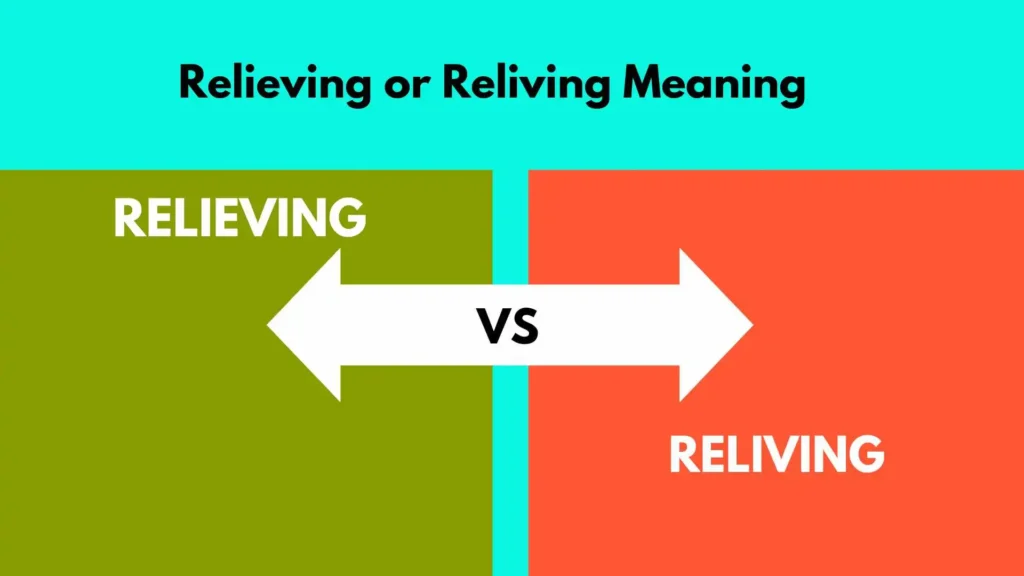
The words relieving and reliving may look similar, but they have different meanings. Relieving means reducing pain, stress, pressure, or discomfort.
Reliving means experiencing a past event again in your mind, often through memories. Understanding the difference helps you use each word correctly in writing and conversation.
Relieving or Reliving Synonym
Relieving synonyms include comforting, easing, soothing, reducing, and alleviating. These words describe making a difficult situation feel better.
Reliving synonyms include remembering, recalling, revisiting, reenacting, and reminiscing. These words relate to thinking about or mentally experiencing past events again.
Relieving Meaning
Relieving is the present participle of the verb relieve. It refers to removing or reducing pain, anxiety, stress, or responsibility.
For example, taking medicine may be relieving a headache, while sharing a problem with a friend can be relieving emotional stress.The word is often used in medical, emotional, and everyday contexts.
Relieving or Reliving Examples
- The cold drink was relieving my thirst after a long walk.
- Talking to her was relieving because it reduced my anxiety.
- He spent the evening reliving his childhood memories.
## Why Confusion Happens Between Relieving vs Reliving
Many learners confuse Relieving vs Reliving because:
- They look almost identical in spelling
- They sound very similar in pronunciation
- Both are emotional words
- Both are used in daily communication
👉 Even native speakers sometimes mix them in casual speech.
## Grammar Rules for Relieving vs Reliving
### Relieving (Verb: Relieve)
Relieving is the present participle of relieve.
It is used when something is reducing pain or stress.
Structure:
Subject + is/are + relieving + object
Examples:
- The doctor is relieving the patient’s pain.
- This cream is relieving irritation.
👉 Focus: Present comfort or improvement
### Reliving (Verb: Relive)
Reliving is the present participle of relive.
It is used when someone is experiencing a memory again.
Structure:
Subject + is/are + reliving + memory/event
Examples:
- She is reliving her past experiences.
- He is reliving the accident in his mind.
👉 Focus: Past memory replay
## Memory Tricks to Remember Relieving vs Reliving
Here are easy tricks to never confuse them again:
💡 Trick 1: Relief vs Replay
- Relieving = Relief (pain disappears)
- Reliving = Replay (memory repeats)
Trick 2: Letter clue
- Relieving → V = Victory over pain
- Reliving → Live again (memory replay)
💡 Trick 3: Simple association
- Pain → Relieving
- Past → Reliving
👉 Just remember:
Relief for Relieving, Replay for Reliving
## Side-by-Side Comparison of Relieving vs Reliving
| Feature | Relieving | Reliving |
| Meaning | Reducing pain or stress | Experiencing again |
| Time | Present | Past memory |
| Emotion | Comfort, relief | Nostalgia, emotion |
| Root Verb | Relieve | Relive |
| Example | Relieving headache | Reliving childhood |
## Real-Life Examples of Relieving vs Reliving
### Relieving Examples
- The medicine is relieving pain quickly.
- Exercise helps in relieving stress.
- Music is relieving anxiety.
- The massage is relieving muscle tension.
👉 Think: Something improving your current condition
### Reliving Examples
- He is reliving his school memories.
- She is reliving her graduation day.
- Watching old videos made me relive my childhood.
- The photo album is reliving old moments.
👉 Think: Something from the past coming back in your mind
## 🌍 British vs American English (Relieving vs Reliving)
Good news: There is no difference in spelling or meaning between British and American English for these words.
Both use them in the same way:
🇬🇧 British English
- The treatment is relieving pain effectively.
- He is reliving old memories.
🇺🇸 American English
- The treatment is relieving pain effectively.
- He is reliving old memories.
👉 Conclusion:
No variation exists. Only usage context matters.
## Common Mistakes with Relieving vs Reliving
Here are frequent errors learners make:
❌ I am reliving my headache
✔ I am relieving my headache
This medicine is reliving stress
This medicine is relieving stress
❌ She is relieving her childhood memories
✔ She is reliving her childhood memories
👉 Tip: Always check meaning before using the word.
## Pro Tips for Using Relieving vs Reliving Correctly
✔ Always check if it is pain or memory
✔ Replace “relieving” with “reducing” to test meaning
✔ Replace “reliving” with “re-experiencing”
✔ Read full sentence before final choice
✔ Practice daily writing to improve accuracy
👉 Small practice = big improvement in grammar accuracy
## FAQ: Relieving vs Reliving
1. What is the main difference between relieving and reliving?
Relieving reduces pain or stress, while reliving means experiencing something again.
2. Is reliving used for pain?
No, it is used for memories, not pain.
3. What is relieving used for?
It is used for stress, pain, or discomfort.
4. Are relieving and reliving interchangeable?
No, they have completely different meanings.
5. Why do people confuse them?
Because they look and sound very similar.
6. Can reliving be positive?
Yes, it is often used for happy memories.
7. Which word is correct for stress reduction?
Relieving is correct.
## Conclusion: Mastering Relieving vs Reliving
Understanding Relieving vs Reliving helps you avoid one of the most common English mistakes. Although both words look similar, their meanings are very different:
- Relieving = reducing pain or stress
- Reliving = experiencing memories again
By remembering simple tricks like Relief = Relieving and Replay = Reliving, you can easily master their usage.
Read More Articles
Babys or Babies: Which One Is Correct? (Complete Grammar Guide)
Vender vs Vendor: Meaning, Difference, and Correct Usage Explained
Phoenix vs Pheonix Explained: Stop Making This Common Mistake Today
Sence or Sense? Quick Grammar Fix for Everyday Writing
Babys or Babies: Which One Is Correct? (Complete Grammar Guide)