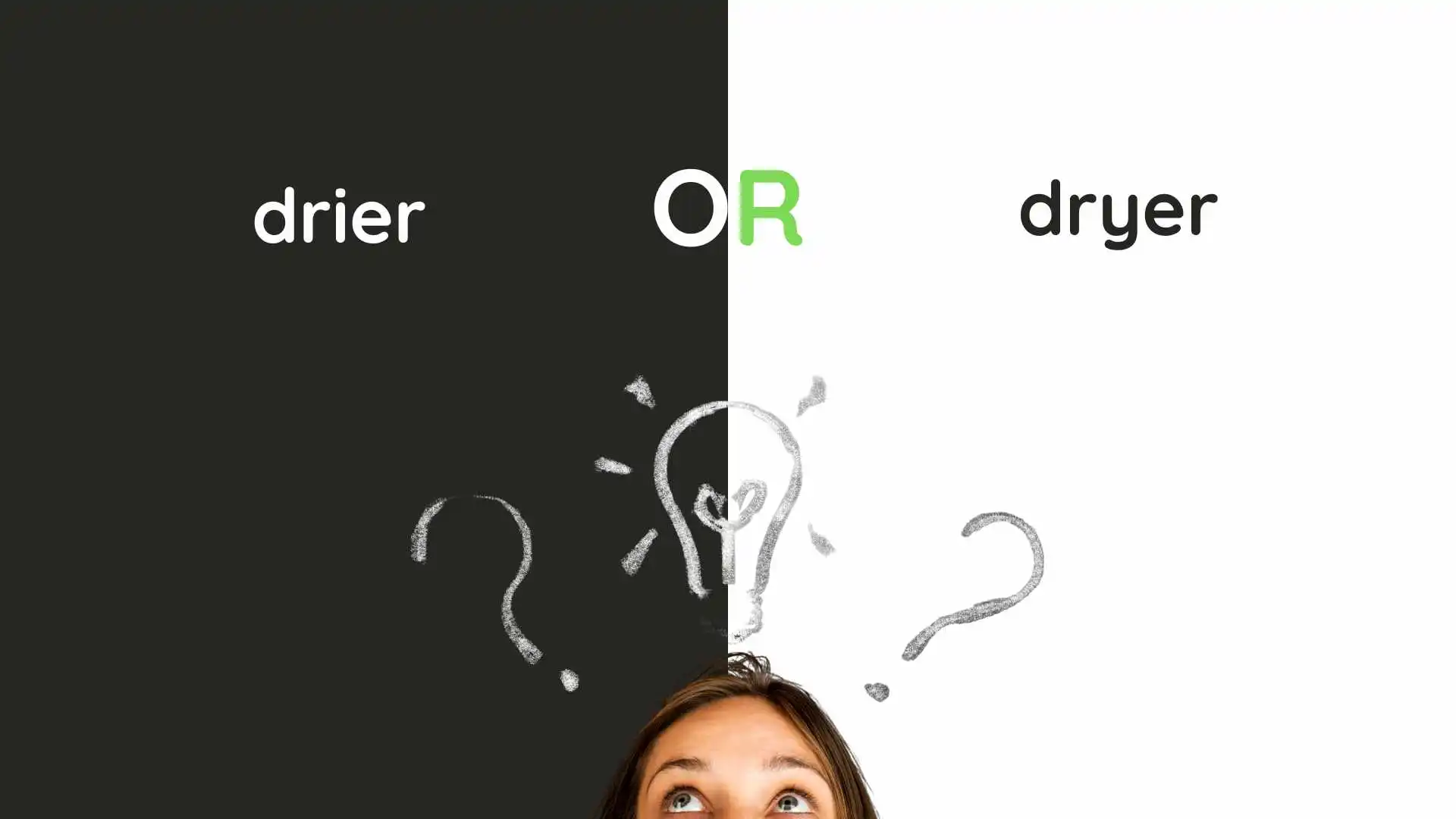
Have you ever been confused while writing and suddenly paused at the words “drier or dryer”? You are not alone. Many English learners, writers, and even native speakers struggle with these two spellings because they look almost identical but are used in different contexts.
The confusion often appears when talking about weather, machines, or comparisons like “this towel is drier than that one.” At the same time, you also see “dryer” on home appliances like clothes dryers. So, which one is correct?
In this complete guide, we will clearly break down everything about drier or dryer, including meanings, grammar rules, real-life examples, memory tricks, and common mistakes—so you never get confused again.
⚡ Quick Answer: Drier or Dryer?
Here is the simplest and most correct explanation:
- Drier → Used when comparing how dry something is (adjective form)
- Dryer → A machine or tool that dries things (noun form)
✔ Correct Usage:
- “This towel is drier than the other one.”
- “Put the clothes in the dryer.”
❌ Incorrect Usage:
- “This towel is dryer than the other one.” (wrong in grammar context)
- “The drier is running.” (wrong if referring to machine)
👉 Quick Trick:
If you’re talking about comparison → drier
If you’re talking about a machine → dryer
📘 Meaning and Definition of Drier or Dryer
To fully understand drier or dryer, we must first look at their meanings individually.
🔹 Drier (Adjective / Comparative Form)
“Drier” is the comparative form of “dry.” It means something has less moisture than something else.
Examples:
- The air today is drier than yesterday.
- My shirt is drier after hanging in the sun.
🔹 Dryer (Noun)
“Dryer” refers to a machine or device used to remove moisture.
Examples:
- A hair dryer helps dry wet hair quickly.
- The clothes dryer is in the laundry room.
👉 In simple words:
- Drier = condition (how dry something is)
- Dryer = object (machine/tool)
🤔 Why Confusion Happens Between Drier or Dryer
The confusion between drier or dryer happens because:
1. Same pronunciation
Both words sound almost identical in speech.
2. Similar spelling
Only one letter “i” vs “y” makes the difference.
3. Grammar overlap
Both come from the word “dry,” making it harder to distinguish.
4. Context dependency
Meaning changes completely based on usage in a sentence.
👉 That’s why even fluent speakers sometimes hesitate while writing.
📏 Grammar Rules for Drier or Dryer
Understanding grammar rules makes everything simple.
🔹 Rule 1: Comparative Adjective
Use drier when comparing two things.
- A is drier than B
- Weather today is drier than yesterday
🔹 Rule 2: Noun (Appliance or Machine)
Use dryer when referring to equipment.
- Hair dryer
- Clothes dryer
- Hand dryer
🔹 Rule 3: Do NOT mix both
Never use “dryer” for comparison or “drier” for machines.
🧠 Easy Memory Tricks to Remember Drier or Dryer
Here are simple tricks to never forget the difference:
Trick 1: “I” stands for “Intensity”
- Drier = comparison (intensity of dryness)
Trick 2: “Y” stands for “Your appliance”
- Dryer = your machine at home
💡 Trick 3: Think like this:
- If you can TOUCH it (machine) → Dryer
- If you can COMPARE it → Drier
📊 Side-by-Side Comparison Table: Drier or Dryer
| Feature | Drier | Dryer |
| Word Type | Adjective (comparative) | Noun |
| Meaning | More dry than something else | Machine that dries things |
| Usage | Weather, clothes, conditions | Appliances |
| Example | This room is drier than that one | The dryer is running |
| Context | Comparison | Object/tool |
✍️ Real-Life Examples of Drier or Dryer
🌤 Weather Examples
- Summer air is drier than monsoon season.
- Desert regions are extremely drier than coastal areas.
👕 Clothing Examples
- My jeans are now drier after hanging outside.
- Put wet clothes in the dryer.
💇 Hair Care Examples
- My hair feels drier in winter.
- Use a hair dryer after showering.
🏠 Household Examples
- The laundry room has a dryer and washing machine.
- Towels become drier faster in sunlight.
🌍 British vs American English: Drier or Dryer
When it comes to drier or dryer, there is no major difference between British and American English in meaning.
However, usage context remains the same in both:
✔ British English
- Drier = comparative adjective
- Dryer = machine
✔ American English
- Same rules apply
Examples:
- UK: “The air is drier today.”
- US: “The air is drier today.”
- UK: “Put clothes in the dryer.”
- US: “Put clothes in the dryer.”
👉 Conclusion: Spelling rules are universal for both.
❌ Common Mistakes with Drier or Dryer
Many learners make these mistakes:
❌ Mistake 1:
- “My clothes are dryer than before.”
✔ Correct: “My clothes are drier than before.”
Mistake 2:
- “The drier is not working.”
✔ Correct: “The dryer is not working.”
Mistake 3:
- Mixing both in same sentence incorrectly.
🧠 Common Confusions Explained
💭 “Can dryer also mean comparison?”
No. “Dryer” is never used for comparison.
💭 “Is drier used as a machine ever?”
No. Machines always use “dryer.”
💭 “Why not just use one spelling?”
Because English uses spelling variations to distinguish meaning clearly.
🚀 Pro Tips to Use Drier or Dryer Correctly
Here are expert tips to avoid mistakes:
✔ Tip 1:
Always check if the word is describing a thing or comparison
✔ Tip 2:
Think of household appliances → always “dryer”
✔ Tip 3:
If you can add “than” in sentence → use “drier”
✔ Tip 4:
Read your sentence out loud—context becomes clearer
❓ Frequently Asked Questions (FAQ)
1. What is the difference between drier and dryer?
“Drier” is comparative (more dry), while “dryer” is a machine.
2. Is it correct to say clothes are dryer?
No, correct word is “drier.”
3. What is a dryer used for?
A dryer is used to remove moisture from clothes or hair.
4. Can drier be a noun?
No, “drier” is mainly used as an adjective.
5. Why are drier and dryer confusing?
Because they sound similar and differ by only one letter.
6. Which spelling is used for machines?
“Dryer” is used for machines.
7. How do I remember drier vs dryer easily?
Drier = comparison, Dryer = device (machine).
📌 Conclusion: Drier or Dryer Made Simple
Understanding drier or dryer becomes easy once you know the basic rule: one is for comparison, and the other is for machines. “Drier” describes how dry something is, while “dryer” refers to a device used in homes and salons.
Now you can confidently use both words correctly in writing, speaking, and exams without confusion. With practice and memory tricks, you will never mix them again.
👉 Remember: Drier = Degree of dryness | Dryer = Device that dries