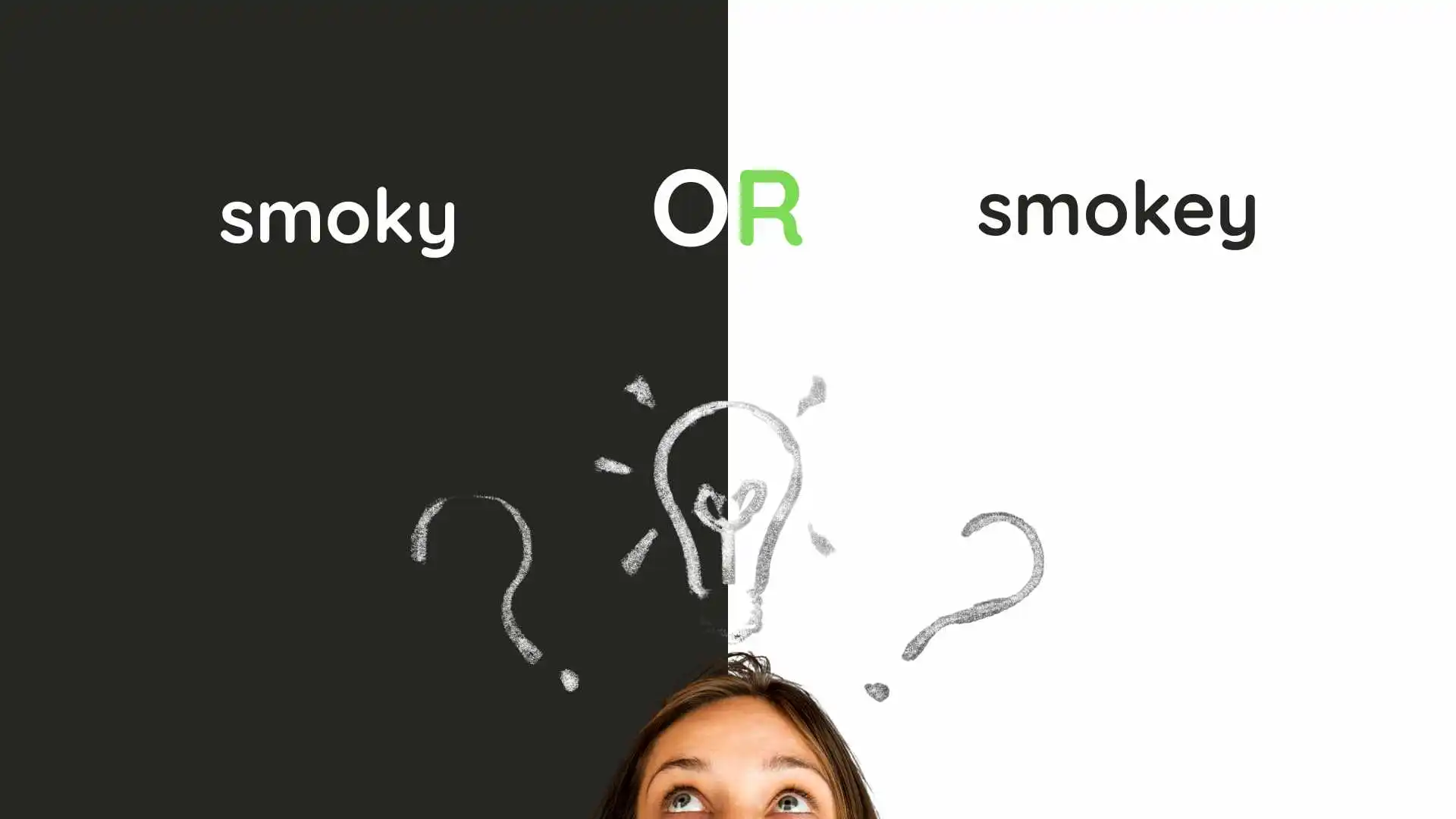
Have you ever paused while writing and wondered whether it’s “smoky” or “smokey”? You’re not alone this tiny spelling difference confuses a lot of people, especially when both versions seem correct at first glance.
In everyday writing, choosing the right word matters because it can change how professional and clear your message feels. Whether you’re describing a smoky flavor, a foggy sky, or even a name, knowing the correct form helps you avoid common mistakes.
In this guide, we’ll break down the difference between smoky vs smokey, explain when to use each one, and give you simple examples so you’ll never get confused again. ✨
⚡ Quick Answer: Smoky or Smokey?
- ✅ Smoky = Correct standard spelling (used in most cases)
- ⚠️ Smokey = Rare variant, mainly used in names or proper nouns
👉 Use “smoky” in general writing.
👉 Use “smokey” only in specific names or stylistic contexts.
📖 Meaning and Definition of Smoky vs Smokey
🔹 What Does “Smoky” Mean?
Smoky is the standard and widely accepted spelling in English.
It means:
- Filled with smoke
- Having a smell, taste, or appearance of smoke
- Slightly dark, hazy, or mysterious
📌 Examples:
- The room was filled with smoky air.
- This barbecue has a delicious smoky flavor.
- She wore smoky eye makeup.
👉 This is the form you should use in 99% of cases.
🔹 What Does “Smokey” Mean?
Smokey is a less common alternative spelling, and it is not typically used in standard writing.
It appears mainly in:
- Proper names
- Nicknames
- Brand names
📌 Examples:
- Smokey (a person’s nickname)
- Smokey Bear (famous mascot)
- Smokey Mountain references
👉 Outside of names, “smokey” is usually considered incorrect.
🤔 Why Does the Confusion Happen?
The confusion between smoky or smokey happens for a few key reasons:
1. Spelling Patterns in English
Many adjectives in English end in -ey (like honey or money), so people assume “smokey” follows the same rule.
2. Sound Similarity
Both words sound exactly the same:
👉 /ˈsmoʊki/
So, when writing, people rely on guesswork.
3. Influence of Names
Because “Smokey” is used in names, people mistakenly think it’s the standard spelling.
4. Informal Writing Habits
Social media and casual texting often ignore strict spelling rules, spreading incorrect forms.
📚 Grammar Rules You Should Know
Here’s the simple grammar rule:
👉 When forming adjectives from nouns ending in “-e,” drop the “e” and add “-y.”
- Smoke → Smoky ✅
- Taste → Tasty ✅
- Noise → Noisy ✅
❌ Smoke → Smokey (incorrect by standard rule)
👉 So grammatically, “smoky” follows the correct pattern.
🧠 Easy Memory Tricks (Never Forget Again!)
Here are simple tricks to remember:
🔸 Trick #1: Drop the “E”
Think:
👉 Smoke → Smoky (drop the “e”)
🔸 Trick #2: Think “Tasty”
Just like:
- Taste → Tasty
- Smoke → Smoky
Same rule applies!
🔸 Trick #3: Names Have Extra Letters
👉 If it’s a name, it might be “Smokey”
👉 If it’s a description, it’s “Smoky”
📊 Smoky vs Smokey (Side-by-Side Comparison)
| Feature | Smoky ✅ | Smokey ⚠️ |
| Correct Usage | Standard English | Rare / Non-standard |
| Meaning | Full of smoke / flavor | Usually a name |
| Grammar Rule | Follows spelling rules | Breaks standard pattern |
| Common Contexts | Food, air, atmosphere | Names, brands, nicknames |
| Recommendation | Always use | Avoid in general writing |
✍️ Examples in Real-Life Usage
✅ Correct Sentences with “Smoky”
- The fire created a smoky atmosphere.
- I love the smoky taste of grilled meat.
- Her smoky eyes looked stunning.
- The cabin smelled warm and smoky.
❌ Incorrect Usage
- The food has a smokey flavor. ❌
- The room was smokey. ❌
👉 These should be “smoky.”
⚠️ When “Smokey” Is Correct
- Smokey is my dog’s name.
- Smokey Bear is a famous character.
👉 Here, it’s correct because it’s a proper noun.
🌍 British vs American English
Good news—there’s no major difference here!
🇺🇸 American English
- Uses smoky ✔️
🇬🇧 British English
- Also uses smoky ✔️
👉 Unlike words like “colour/color,” both versions agree on smoky.
📌 Conclusion:
- Smoky = universal standard spelling
- “Smokey” is not a regional variation—it’s mostly stylistic or name-based
❌ Common Mistakes People Make
Here are typical errors:
Mistake #1: Adding “E” Automatically
❌ smokey flavor
✅ smoky flavor
Mistake #2: Copying Informal Writing
Social media often uses incorrect forms.
Mistake #3: Confusing Names with Adjectives
❌ The air was smokey
✅ The air was smoky
💡 Pro Tips to Avoid Mistakes
✔️ Tip #1: Always Default to “Smoky”
If unsure, choose smoky—it’s almost always correct.
✔️ Tip #2: Check Context
Ask yourself:
👉 Is it describing something? → Use smoky
👉 Is it a name? → Maybe smokey
✔️ Tip #3: Use Spell Check
Most grammar tools will flag “smokey” as incorrect.
✔️ Tip #4: Think of Food 🍖
You’ve likely seen:
👉 “Smoky BBQ”
👉 Not “Smokey BBQ”
🔍 Deep Insight: Why “Smoky” Wins in SEO & Writing
If you’re a blogger, writer, or SEO expert, this matters:
📈 Search Trends
- “Smoky flavor” → Highly searched ✔️
- “Smokey flavor” → Low / incorrect usage ❌
📌 SEO Tip:
Using the correct spelling:
- Improves credibility
- Matches search intent
- Boosts rankings
👉 Always optimize for “smoky” in content.
❓ FAQ Section (People Also Ask)
1. Is smoky or smokey correct?
👉 Smoky is correct in standard English. Smokey is mainly used in names.
2. Why do people write smokey?
👉 Due to spelling confusion and influence of names or informal writing.
3. Is smokey ever correct?
👉 Yes, but only in proper nouns or names.
4. How do you spell smoky flavor?
👉 The correct spelling is smoky flavor.
5. Is smoky used in both US and UK English?
👉 Yes, both use smoky as the standard spelling.
6. What is a smoky atmosphere?
👉 It means an environment filled with smoke or haze.
7. How can I remember the correct spelling?
👉 Drop the “e” from “smoke” → smoky.
🧾 Conclusion: Smoky or Smokey—Final Verdict
To sum it up, the debate between smoky or smokey is actually quite simple once you understand the rules.
👉 Smoky is the correct, standard, and widely accepted spelling.
👉 Smokey is only used in names or special cases.
If you’re writing anything from blog posts to emails or social media stick with “smoky” to ensure clarity and correctness.