Have you ever heard someone say “Whether you like it or not” and felt the strong tone behind it? This powerful phrase is commonly used in everyday conversations, social media, and even professional settings to express certainty or inevitability.
In today’s fast-paced digital world, phrases like this carry extra weight. Whether you’re texting a friend, writing a caption, or communicating at work, understanding the true meaning and correct usage of “whether you like it or not” can make your message clearer and more impactful.
In this guide, you’ll discover what this phrase really means, how to use it naturally in sentences, and when it’s appropriate (or not!) to say it.
⚡ Quick Answer Section: Nevermind vs Never Mind
Here is the simplest explanation:
✔️ Correct Usage:
- Never mind → Correct and standard English ✔️
- Nevermind → Informal, often incorrect in formal writing ✔️
✔️ Final Rule:
- Use “Never mind” (two words) in almost all situations
❌ Incorrect usage:
- Nevermind (in formal writing) ❌
- Never-mind ❌
👉 Quick takeaway:
If you want to write correctly in exams, blogs, or professional English, always choose Never mind.
📘 Meaning of Nevermind vs Never Mind
To understand Nevermind vs Never Mind, we first need to break down the meaning.
✔️ “Never mind” (correct form)
It is a phrase that means:
- “Don’t worry about it”
- “Forget what I just said”
- “It is not important anymore”
✔️ Example:
- “Never mind, I’ll do it myself.”
❌ “Nevermind” (incorrect or informal usage)
- This is often used mistakenly as a single word
- It is popular in casual texting or slang
- Not recommended in formal English writing
👉 So, both expressions come from the same idea, but only “never mind” is grammatically correct in standard English.
Nevermind Shortcut
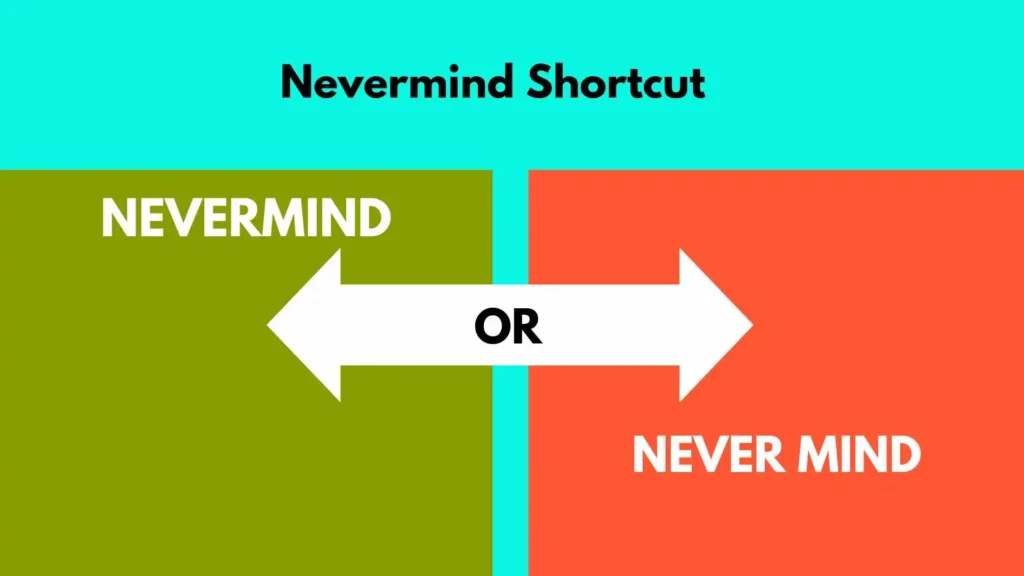
The shortcut “nevermind” is often used in text messages, chats, and social media as a quick way to say “forget it” or “it doesn’t matter anymore.” People use it when a question has already been answered or when they no longer need help.
Common abbreviations include “nvm” and “nm.” These shortcuts make conversations faster and more casual online.
Nevermind Meaning
Nevermind means don’t worry about it, forget what I said, or it’s no longer important. It is commonly used when someone changes their mind or no longer needs an answer.
For example, if you ask a question and then find the answer yourself, you might reply, “Nevermind, I figured it out.” The phrase is widely used in both spoken and written English.
Nevermind vs Never Mind Grammar
In grammar, “never mind” is the traditionally correct two-word phrase used in formal English. It functions as an expression meaning “don’t worry” or “ignore that.
“ The one-word version, “nevermind,” is commonly seen in informal writing, text messages, and online conversations. For professional or academic writing, “never mind” is generally the preferred choice.
Never Mind Slang
As slang, “never mind” is often used casually to dismiss a topic or end a conversation about something. It can mean “forget it,” “don’t bother,” or “it doesn’t matter anymore.”
In online chats, people frequently shorten it to “nvm.” The slang usage is especially popular among younger users on social media and messaging apps.
Nevermind or Never Mind Examples
- Never mind, I found the information myself.
- Never mind what they said; focus on your work.
- Nevermind, the problem has already been solved
❓ Why Confusion Happens in Nevermind vs Never Mind
Many learners struggle with Nevermind vs Never Mind because English often merges phrases into single words over time.
🔹 1. Fast texting culture
People write quickly and combine words:
- never + mind → nevermind
🔹 2. Influence of slang and social media
Informal platforms often ignore grammar rules.
🔹 3. Sound similarity
Both versions sound identical when spoken.
🔹 4. Word evolution in English
Some phrases naturally become single words over time, but this one has NOT fully changed.
👉 That’s why confusion continues even today.
📏 Grammar Rules for Nevermind vs Never Mind
Understanding grammar helps you avoid mistakes easily.
✔️ Rule 1: “Never mind” is a phrase
- It is made of two separate words
- Used in formal and informal English
✔️ Rule 2: Used as an imperative phrase
It often gives a command or suggestion:
- “Forget it”
- “Don’t worry”
✔️ Rule 3: Not a noun or single word
- “Nevermind” is NOT a standard dictionary-approved form in formal grammar
✔️ Rule 4: Always separate in writing
- Correct: Never mind
- Incorrect: Nevermind
🧠 Memory Tricks to Remember Nevermind vs Never Mind
Here are simple tricks to help you remember forever:
🎯 Trick 1: Think “Mind your space”
- Two words = correct → Never mind
Trick 2: Grammar rule shortcut
- English phrases = usually separate words
🎯 Trick 3: Break it mentally
- Never + mind = never mind
Trick 4: Exam rule
- If it’s an exam or formal writing → always separate
📊 Side-by-Side Comparison: Nevermind vs Never Mind
| Feature | Nevermind | Never Mind |
| Correctness | Informal / incorrect | Correct ✔️ |
| Structure | One word | Two words |
| Usage | Texting / slang | Formal + informal |
| Grammar status | Not standard | Standard English |
| Recommended | No | Yes ✔️ |
👉 Final conclusion: Never mind is always the safer and correct option.
✍️ Examples of Nevermind vs Never Mind in Sentences
Let’s understand usage with real-life examples:
✔️ Correct usage (Never mind):
- “Never mind, I’ll fix it later.”
- “If you don’t understand, never mind for now.”
- “Never mind what I said earlier.”
❌ Incorrect usage (Nevermind):
- “Nevermind, I will do it.” ❌ (avoid in formal writing)
- “Nevermind about it.” ❌
💡 Everyday conversation examples:
- “Did you call me?”
“Never mind, it was a mistake.”
👉 This shows how naturally the phrase is used in speech.
🌍 British vs American English: Nevermind vs Never Mind
Interestingly, both British and American English agree on this rule.
🇬🇧 British English:
- Correct form: Never mind
- “Nevermind” is considered informal or incorrect
🇺🇸 American English:
- Also uses: Never mind
- “Nevermind” appears in casual texting but not formal writing
✔️ Example comparison:
- UK: “Never mind, it’s fine.”
- US: “Never mind, it’s okay.”
👉 Both regions prefer two-word usage officially.
⚠️ Common Mistakes with Nevermind vs Never Mind
❌ Incorrect vs ✔️ Correct
- Nevermind ❌ → Never mind ✔️
- Never-mind ❌ → Never mind ✔️
- Never mind me ❌ → Never mind ✔️
🔴 Most common error:
People think combining words makes writing modern—but in grammar, it often makes it wrong.
🚀 Pro Tips for Using Nevermind vs Never Mind Correctly
✔️ Tip 1: Always use two words in exams
Never risk writing “nevermind” in academic writing.
✔️ Tip 2: Think of it as a phrase, not a word
It expresses a full idea.
✔️ Tip 3: Avoid slang in professional writing
Even if texting allows “nevermind,” formal writing does not.
✔️ Tip 4: Remember the golden rule
👉 If unsure → always write “never mind”
🧩 Real-Life Usage Contexts of Nevermind vs Never Mind
You will often see this phrase in:
- 💬 Daily conversations
- 📱 Text messages
- 📧 Emails
- 📖 Story writing
- 🎬 Movie dialogues
Example in conversation:
- A: “Should I explain again?”
- B: “No, never mind, I got it.”
❓ FAQ: Nevermind vs Never Mind
1. Is “nevermind” correct English?
No, the correct form is “never mind.”
2. What does never mind mean?
It means “don’t worry about it” or “forget it.”
3. Can I use nevermind in texting?
Yes, but it is informal and not grammatically correct.
4. Which is correct: nevermind or never mind?
Never mind is correct.
5. Is nevermind accepted in British English?
No, British English prefers “never mind.”
6. Why do people write nevermind?
Because of fast typing and slang usage.
7. Is never mind formal or informal?
It is acceptable in both formal and informal English.
🧾 Conclusion: Nevermind vs Never Mind Explained Clearly
Understanding Nevermind vs Never Mind is important for anyone learning English because it clears one of the most common grammar mistakes. While both forms are widely seen online, only “never mind” (two words) is considered correct in standard English.
Read More Articles
More Then or More Than: Which One Is Correct? (Complete Guide)
Mangoes or Mangos: Which One Should You Use in Writing? 2026
Sheath or Sheathe: Meaning, Difference, and Correct Usage Explained (2026 Guide)
Confused Between Optimize and Optimise? Read This First 2026