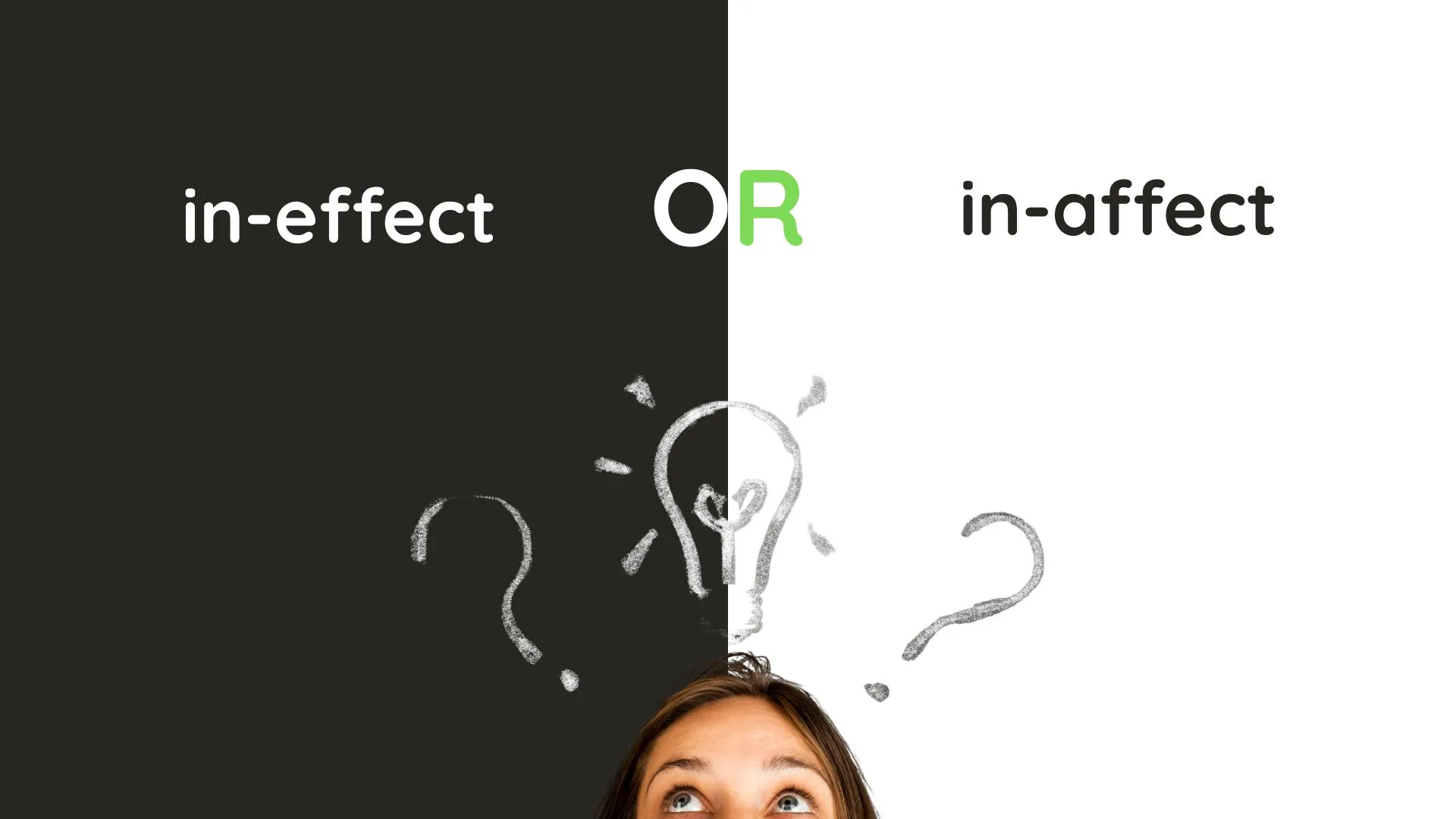
Have you ever paused while writing and wondered whether to use “in effect” or “in affect”? 🤔 You’re not alone. These two phrases look almost identical, which makes them easy to confuse in emails, essays, social media posts, and everyday conversations.
But here’s the surprising part: one of them is commonly correct, while the other is rarely used in standard English. Understanding the difference between “in effect vs in affect” can instantly improve your writing clarity and help you avoid a mistake many people make without realizing it.
You’re a student, blogger, professional writer, or just someone who wants better grammar, this guide will explain everything in a simple and easy-to-understand way.
⚡ Quick Answer Section: In Effect vs In Affect
✔️ Correct phrase:
- In effect → Correct ✔️ (means “in force” or “in reality”)
❌ Incorrect phrase:
- In affect → Incorrect ❌ (not used in standard English)
👉 Final answer: Always use IN EFFECT
📘 Meaning and Definition of In Effect vs In Affect
H3: Meaning of “In Effect”
The phrase in effect has two main meanings:
1. In force / officially active
Used when something is currently valid or working.
Example:
- The new law is in effect from today.
2. In reality / essentially
Used to explain the true meaning of a situation.
Example:
- His decision was, in effect, a refusal.
👉 It works like saying: basically or in reality
H3: Meaning of “In Affect”
- In affect is NOT a correct English phrase ❌
- It is usually a mistake caused by confusion between “affect” and “effect”
👉 Important:
- “Affect” is a verb (to influence)
- “Effect” is a noun (result)
So “in affect” does not make grammatical sense.
❓ Why Confusion Happens Between In Effect vs In Affect
H3: 1. Similar pronunciation
Both phrases sound almost the same when spoken.
H3: 2. Affect vs Effect confusion
Many learners already struggle with these two words.
H3: 3. Spelling similarity
Only one letter difference makes it easy to mix up.
H3: 4. Lack of grammar awareness
People don’t realize “affect” cannot fit in this phrase.
👉 That’s why this mistake is extremely common.
📏 Grammar Rules for In Effect vs In Affect
H3: Rule 1: “In effect” is a fixed phrase
It is a standard expression in English.
H3: Rule 2: “Effect” works as a noun
It fits naturally in the phrase.
H3: Rule 3: “Affect” is usually a verb
It cannot be used after “in” like this.
H3: Rule 4: Always avoid “in affect”
It is considered incorrect in formal and informal writing.
🧠 Memory Tricks to Remember In Effect vs In Affect
H3: Trick 1: “Effect = End result”
If something is active or real → use effect
H3: Trick 2: “Affect = Action”
Affect is a verb → cannot fit in this phrase
H3: Trick 3: Think “Law in effect”
We always say laws are in effect, not “in affect”
H3: Trick 4: SEO trick
Always remember: In effect = correct keyword
📊 Side-by-Side Comparison: In Effect vs In Affect
| Feature | In Effect | In Affect |
| Correct in English | ✔️ Yes | ❌ No |
| Meaning | In force / in reality | No meaning |
| Grammar role | Phrase (noun-based) | Incorrect structure |
| Usage | Formal & informal | Not used |
| SEO value | High | Zero |
👉 Conclusion: Only in effect is correct.
✍️ Examples of In Effect in Real-Life Usage
H3: Meaning “in force”
- The new rules are in effect now.
- The policy will remain in effect until next year.
H3: Meaning “in reality”
- His silence was, in effect, an agreement.
- The decision was, in effect, final.
H3: Incorrect Examples (Avoid These)
- The rule is in affect ❌
- His words were in affect a warning ❌
👉 Always replace with in effect
🌍 British vs American English: In Effect vs In Affect
H3: British English
- Uses in effect
- Example: The law is now in effect.
H3: American English
- Also uses in effect
- Example: The rule is in effect immediately.
H3: Key point
- No difference between UK and US usage
- “In affect” is incorrect everywhere
⚠️ Common Mistakes with In Effect vs In Affect
H3: Incorrect vs Correct
- In affect ❌ → In effect ✔️
- Affect result ❌ → Effect result ✔️
- In affect now ❌ → In effect now ✔️
H3: Why mistakes happen
- Confusion between verb and noun
- Phonetic spelling habits
- Lack of grammar clarity
🚀 Pro Tips to Use In Effect Correctly
H3: Tip 1: Think “active rule”
If something is active → use in effect
H3: Tip 2: Replace with “basically”
If sentence still makes sense → correct usage
H3: Tip 3: Avoid guesswork
Always double-check spelling
H3: Tip 4: Practice with examples
Use it daily in sentences
🧩 Real-Life Contexts Where “In Effect” Is Used
- 📜 Laws and policies
- 🏢 Office rules
- 📰 News writing
- 🧠 Explanations and opinions
Example:
- “The curfew is still in effect.”
❓ FAQ: In Effect vs In Affect
H3: 1. What is correct, in effect or in affect?
“In effect” is correct.
H3: 2. Is in affect ever correct?
No, it is always incorrect in English.
H3: 3. What does in effect mean?
It means “in force” or “in reality.”
H3: 4. Why do people confuse these phrases?
Because of affect vs effect confusion.
H3: 5. Can I use in effect in formal writing?
Yes, it is widely accepted.
H3: 6. Is there a difference in British and American English?
No, both use “in effect.”
H3: 7. How can I remember the correct phrase?
Think: “laws are in effect.”
🧾 Conclusion: In Effect vs In Affect Explained Clearly
Understanding In Effect vs In Affect becomes very simple once you know that only one phrase is correct. The phrase “in effect” is widely used in English to describe something that is active or true in reality. On the other hand, “in affect” is incorrect and should always be avoided.