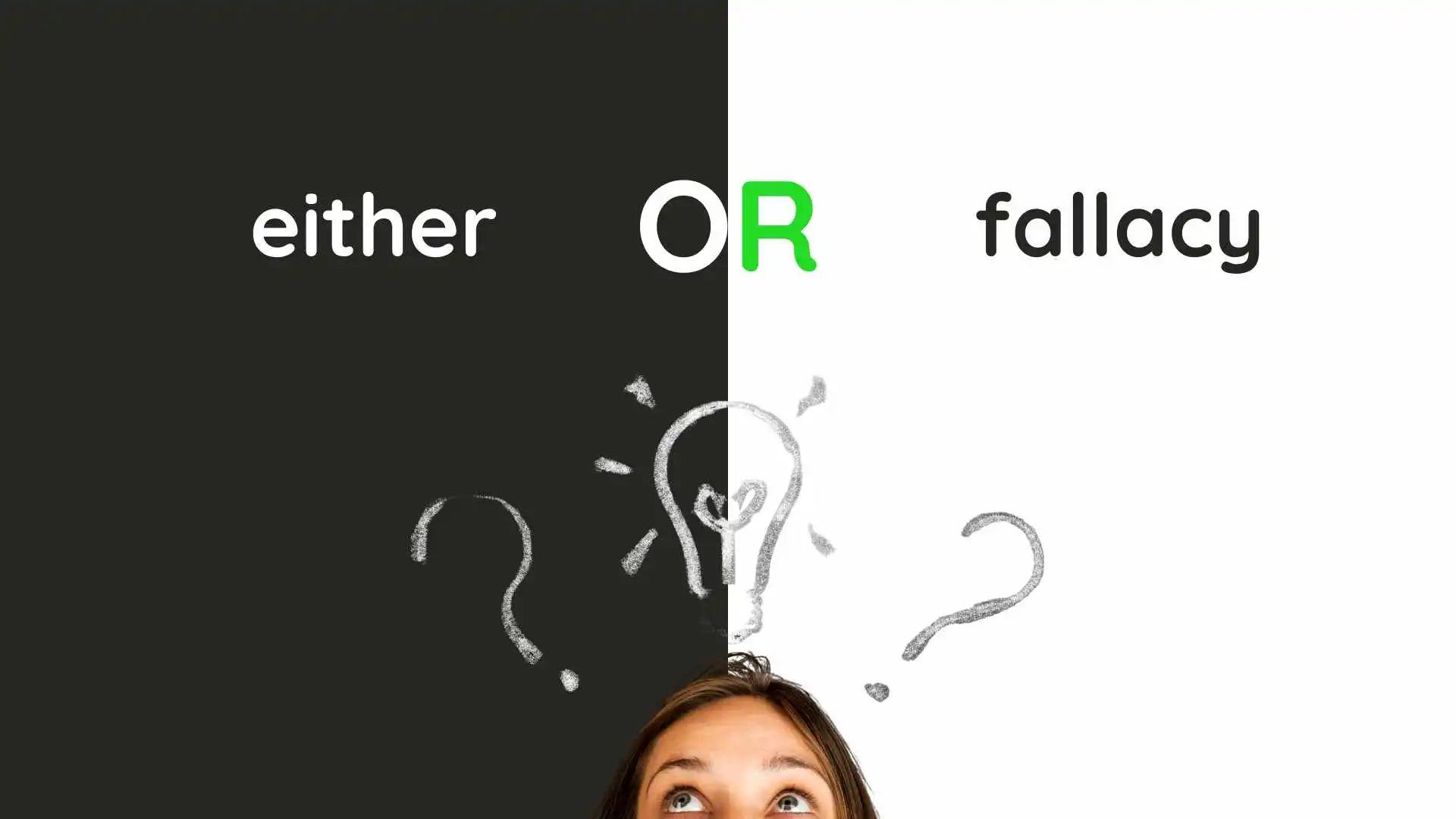
Have you ever heard someone say, “You’re either with us or against us”? 🤔 That’s a classic example of the Either or Fallacy a common thinking mistake where only two choices are presented, even though many other possibilities may exist.
In real life, situations are rarely just black or white. People often use this fallacy in arguments, debates, relationships, politics, and even advertisements to force a simple choice between two extremes.
Understanding the Either or Fallacy can help you think more clearly, avoid manipulation, and make smarter decisions in everyday conversations.
⚡ Quick Answer Section: Either or Fallacy
✔️ What is the Either or Fallacy?
- A logical error that presents only two choices when more options actually exist
❌ Incorrect thinking:
- “You either succeed or you are a total failure” ❌
✔️ Correct thinking:
- “There are many outcomes between success and failure” ✔️
👉 Simple answer: The Either or Fallacy falsely limits choices to just two options.
📘 Meaning and Definition of Either or Fallacy
What does Either or Fallacy mean?
The Either or Fallacy (also called a false dilemma) occurs when someone presents a situation as having only two choices, even though more possibilities exist.
✔️ Simple definition:
A mistake in thinking where only two extreme options are shown, ignoring other alternatives.
✔️ Example:
- “You either love your job or you hate it.”
👉 In reality, someone might feel neutral, unsure, or partially satisfied.
❓ Why Confusion Happens About Either or Fallacy
1. It sounds logical
People often believe two options are enough to explain a situation.
2. Simplicity bias
Our brain prefers simple choices instead of complex thinking.
3. Emotional influence
Strong emotions make people think in extremes.
4. Persuasion tactics
Politicians, marketers, and debaters use it to influence decisions.
👉 That’s why this fallacy is so common in everyday life.
📏 Grammar and Usage Rules of Either or Fallacy
Is “Either or Fallacy” a grammar term?
No, it is not a grammar rule—it belongs to logic and critical thinking.
Correct usage in sentences
- “This argument uses an either or fallacy.”
- “Avoid the either or fallacy in your writing.”
Key point
It is used as a noun phrase to describe flawed reasoning.
🧠 Memory Tricks to Remember Either or Fallacy
Trick 1: Think “Only TWO options”
If you see only two choices → check for fallacy
Trick 2: “Either…or” warning sign
Whenever you hear “either this or that,” pause and question it
Trick 3: Look for missing options
Ask yourself: “Are there more possibilities?”
Trick 4: Think “Real life is not binary”
Life is rarely just black and white ⚫⚪
📊 Side-by-Side Comparison: Either or Fallacy vs Logical Thinking
| Feature | Either or Fallacy | Logical Thinking |
| Choices | Only 2 options | Multiple possibilities |
| Accuracy | Misleading | More realistic |
| Thinking style | Extreme | Balanced |
| Purpose | Persuasion/manipulation | Truth-seeking |
👉 Conclusion: Logical thinking considers more than just two options.
✍️ Examples of Either or Fallacy in Real Life
Everyday life examples
- “If you don’t study all night, you will fail.” ❌
- “You either support this idea or you are against progress.” ❌
Correct thinking
- “Studying helps, but rest is also important.” ✔️
- “You can partially agree or suggest improvements.” ✔️
Examples in relationships
- “If you loved me, you would always agree with me.” ❌
- “Love doesn’t mean agreeing on everything.” ✔️
Examples in education
- “You either get A+ or you are not smart.” ❌
- “Grades don’t fully define intelligence.” ✔️
🌍 British vs American English: Either or Fallacy
Spelling and usage
Good news! There is no difference between British and American English here.
- Both use: Either or Fallacy
- Same meaning and usage worldwide
Minor variation
Sometimes it is called:
- False dilemma (more formal term)
👉 Both terms mean the same thing.
⚠️ Common Mistakes with Either or Fallacy
Mistake 1: Thinking only two options exist
- “You are either right or wrong” ❌
Mistake 2: Ignoring middle ground
- People forget neutral or mixed possibilities
Mistake 3: Using it intentionally
Some use it to manipulate others in debates
Correct approach
- Always look for more than two choices
- Question extreme statements
🚀 Pro Tips to Avoid Either or Fallacy
Tip 1: Ask “What else?”
Always search for additional options
Tip 2: Think in shades, not extremes
Life is not just black or white
Tip 3: Stay calm in debates
Emotions increase fallacy thinking
Tip 4: Use balanced language
Avoid extreme words like “always” or “never”
🧩 Real-Life Situations Where Either or Fallacy Appears
- 🗳️ Politics: “You are either patriotic or against the country”
- 📺 Media: “This is either the best or worst decision ever”
- 💼 Work: “Either meet the deadline or lose your job”
- ❤️ Relationships: “Either you care or you don’t”
👉 In reality, there are always more possibilities.
❓ FAQ: Either or Fallacy
1. What is Either or Fallacy?
It is a logical error where only two options are presented.
2. Is Either or Fallacy the same as false dilemma?
Yes, both mean the same thing.
3. Why is it a problem?
It ignores other valid possibilities.
4. Where is it commonly used?
In debates, politics, media, and daily conversations.
5. How can I avoid it?
Look for more than two options.
6. Is it intentional or accidental?
It can be both.
7. Is it part of grammar?
No, it is part of logic and reasoning.
🧾 Conclusion: Either or Fallacy Explained Clearly
Understanding the Either or Fallacy helps you think more clearly and avoid being misled by oversimplified arguments. This fallacy limits thinking to just two choices, while real life offers many possibilities in between.
To summarize:
- ✔️ It presents only two options
- ✔️ It ignores other possibilities
- ✔️ It is a common logical mistake
- ✔️ It can be avoided with critical thinking